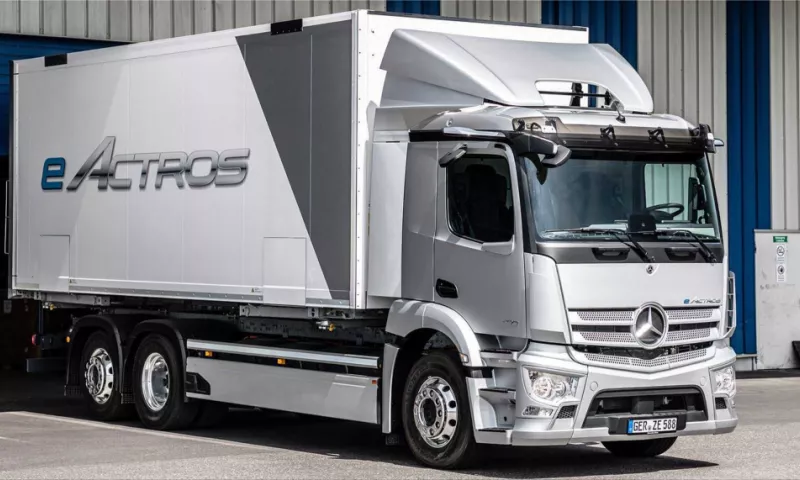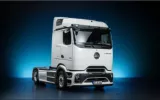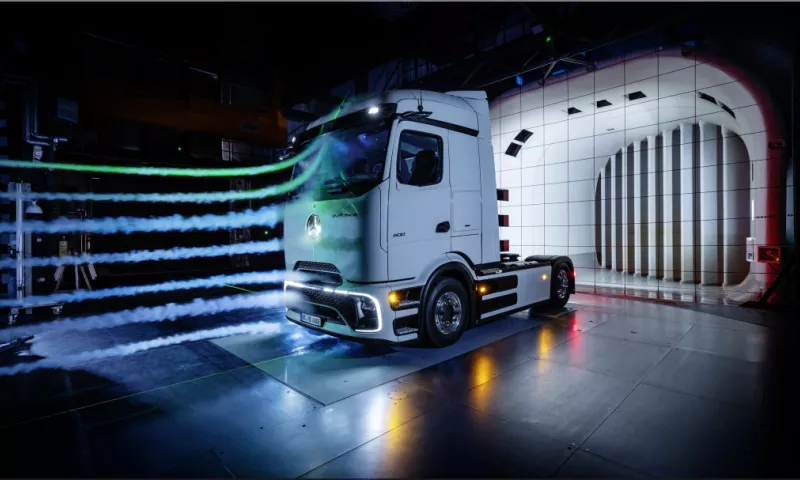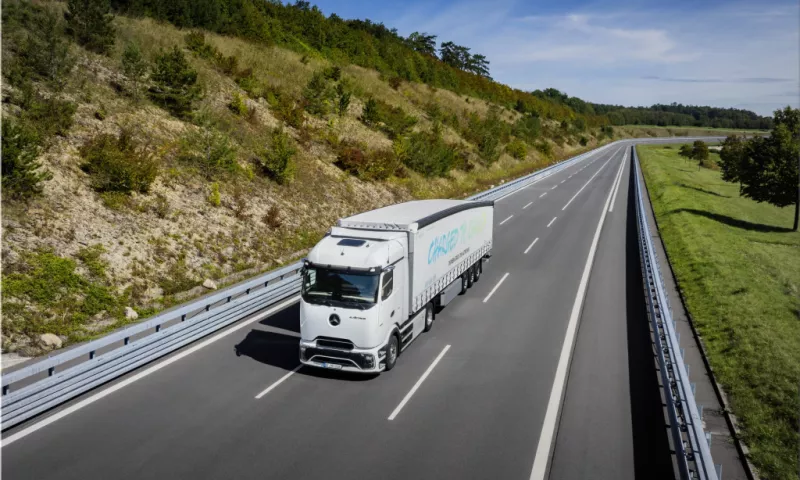

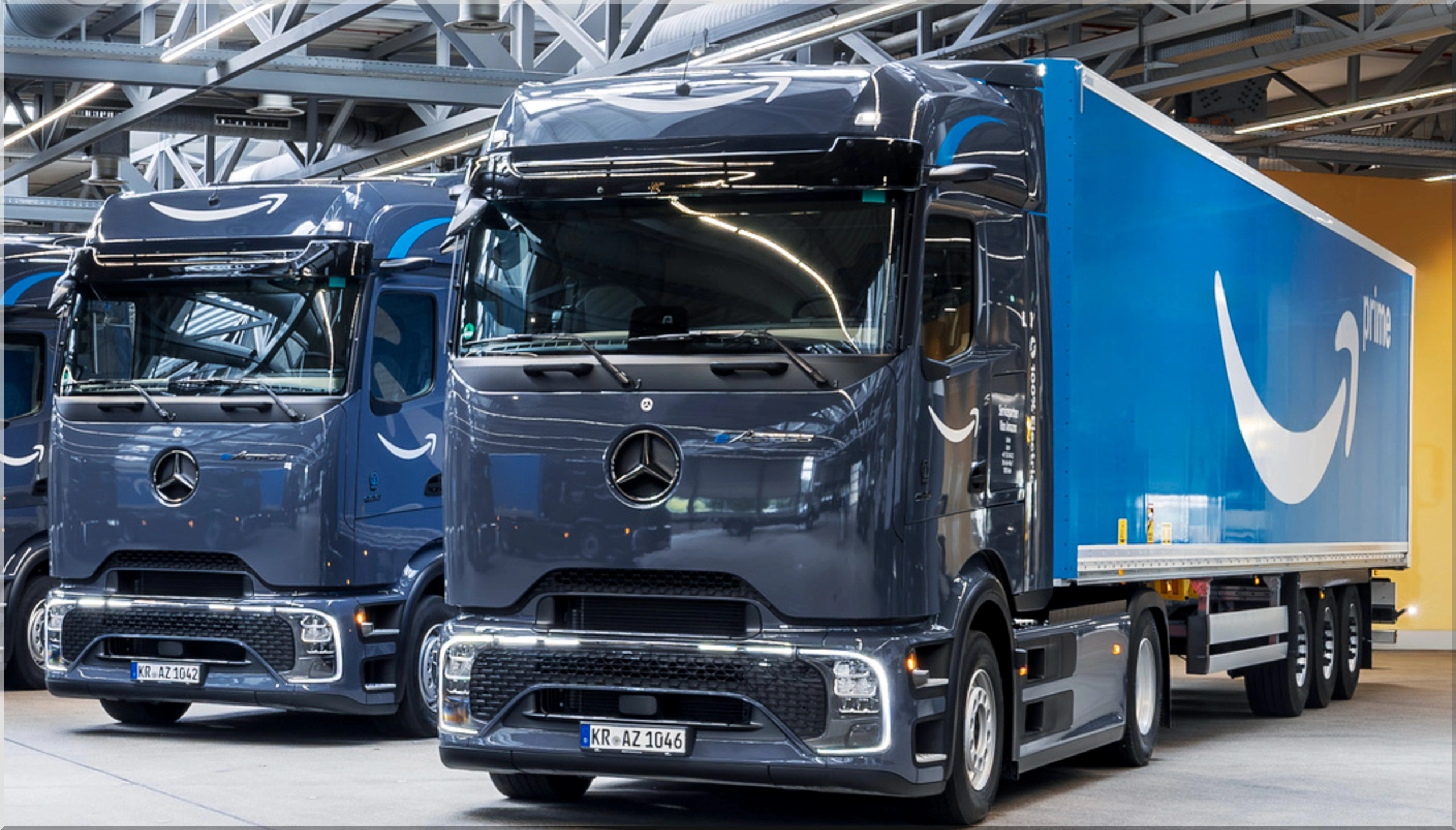
Amazon has started receiving the Mercedes-Benz eActros 600 for its German logistics network, turning a large 2025 purchase agreement into operating capacity. Mercedes-Benz Trucks handed over 27 units first and plans to put more than 50 into Amazon's German middle-mile network by the end of 2026.
What does Amazon's German eActros 600 rollout include?
The German deployment covers high-mileage links between fulfillment centers, sorting sites, and urban delivery stations. Amazon will use these battery-electric heavy trucks where predictable routes and depot dwell time support scheduled charging. The project also gives Mercedes a high-utilization test of long-haul electric hardware at commercial scale.
| Deployment metric | Germany | Wider European order |
|---|---|---|
| Initial handover | 27 trucks | UK deliveries started in late 2025 |
| Planned fleet | More than 50 by end-2026 | More than 200 total |
| Main duty | Middle-mile freight | High-mileage middle-mile routes |
| Package volume | Part of group target | More than 350 million yearly |
In addition, Amazon plans hundreds of heavy-truck chargers at European sites. Its related investment exceeds $1.16 billion across Europe, including roughly $464 million in Germany, based on the ECB's September 11, 2026 reference rate. Amazon and Daimler have not disclosed the truck purchase price.

Can the eActros 600 cover Amazon's middle-mile routes?
Specifically, the truck combines a 621 kWh LFP battery with an in-house 800V eAxle, two motors, and a four-speed transmission. Mercedes quotes 500 km or 311 miles under a 40-tonne test load, while its most efficient three-pack configuration can reach 560 km or 348 miles under stated test conditions.
| Technical measure | eActros 600 data | Fleet implication |
|---|---|---|
| Battery | 3 x 207 kWh, 621 kWh total | More than 590 kWh usable at 95 percent |
| Output | 400 kW continuous, 600 kW peak | About 536 hp continuous, 805 hp peak |
| CCS charging | Up to 400 kW | 10-80 percent in about 70 minutes |
| MCS target | Around 1 MW | 20-80 percent in about 30 minutes |
| Gross combination mass | Up to 44 tonnes or 97,000 lb | EU payload near 22 tonnes or 48,500 lb |
| Durability target | 1.2 million km or 746,000 miles | Over 80 percent battery health after 10 years |
Looking at the data, 590 kWh across 500 km implies an energy allowance near 1.18 kWh/km or 1.90 kWh/mile. By comparison, 50 trucks charging from 10 to 80 percent would request about 21.7 MWh per cycle. From an expert perspective, charger scheduling carries as much operational weight as rated range. Mercedes has not published peak torque.
How should a fleet plan charging for this truck?
Yes, depot charging can keep the eActros 600 productive when dispatchers match charging windows to driver breaks and loading cycles. Consequently, a fleet should model route distance, trailer mass, temperature, auxiliary loads, charger uptime, and power tariffs before assigning a diesel route to an electric tractor.
Pro-Tips for Fleet Managers
- Reserve charging power by departure wave, rather than allowing every truck to plug in at once.
- Keep a route energy buffer for winter heating, congestion, and detours.
- Track delivered kWh per loaded kilometer, charger downtime, and cost per shipment weekly.
- Use the 70-minute 10-80 percent window as the conservative CCS planning case.
The strategic gain comes from repeatable utilization. Amazon's scale can spread charger, training, and maintenance costs across a dense network, while the electric truck fleet cuts tailpipe emissions on routes that run every day.
- Add new comment
- 31 views