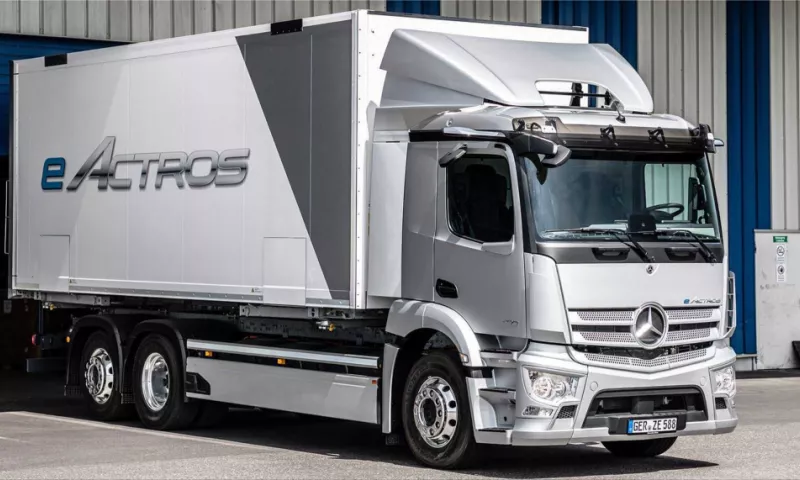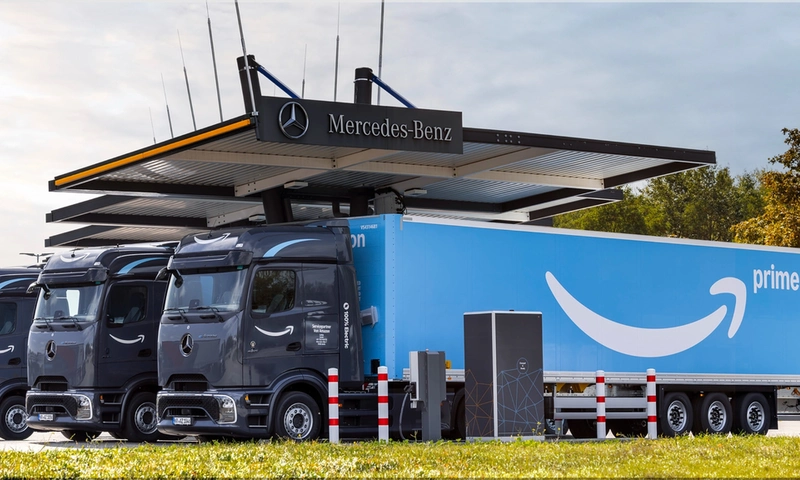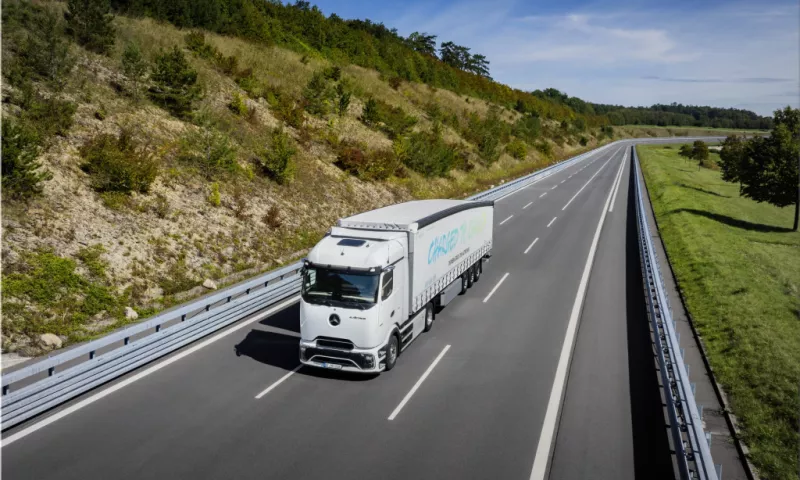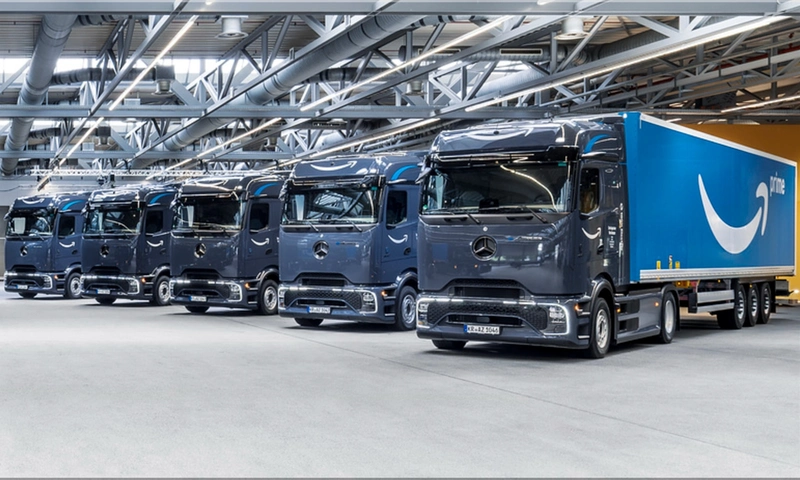
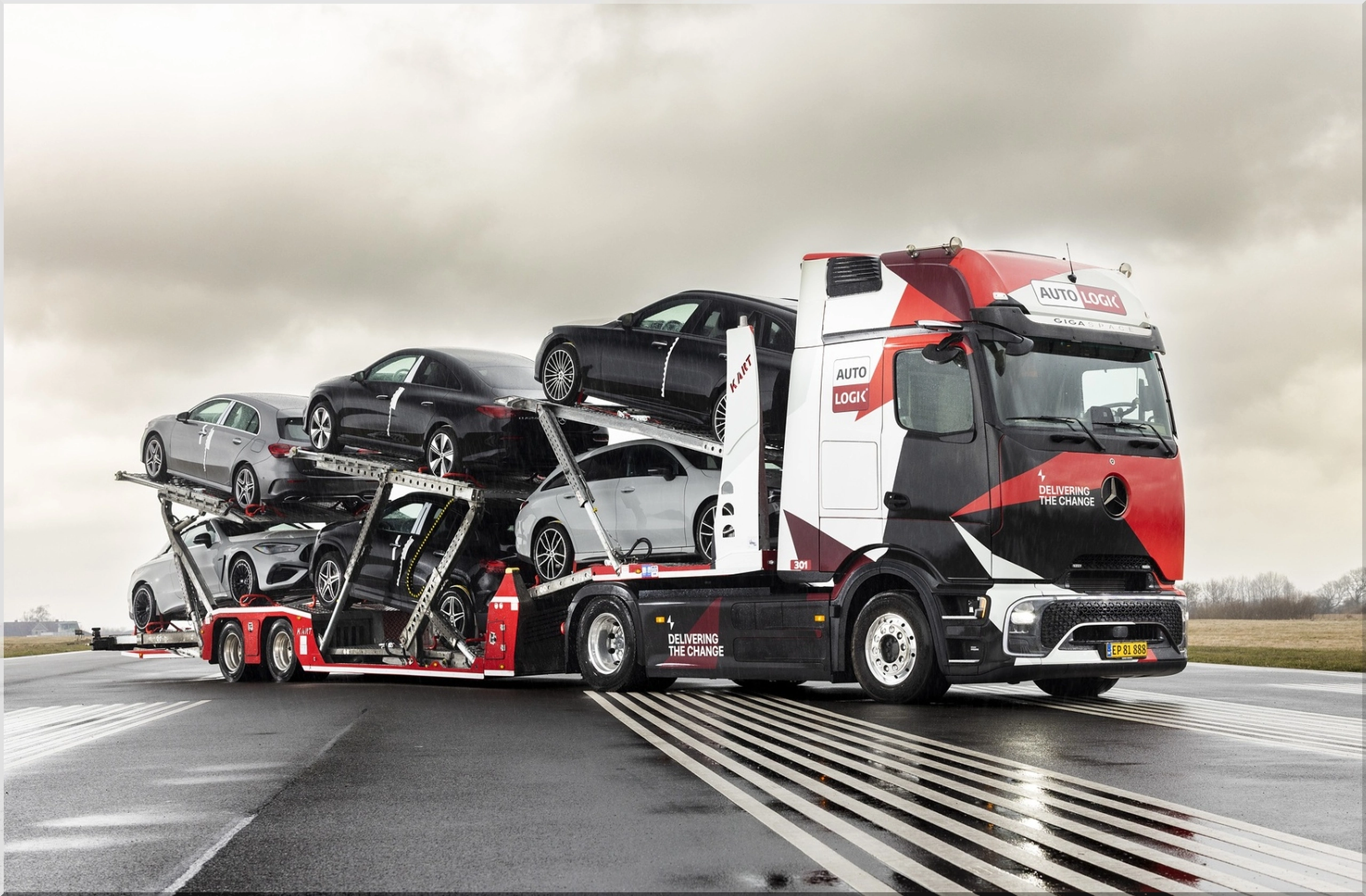
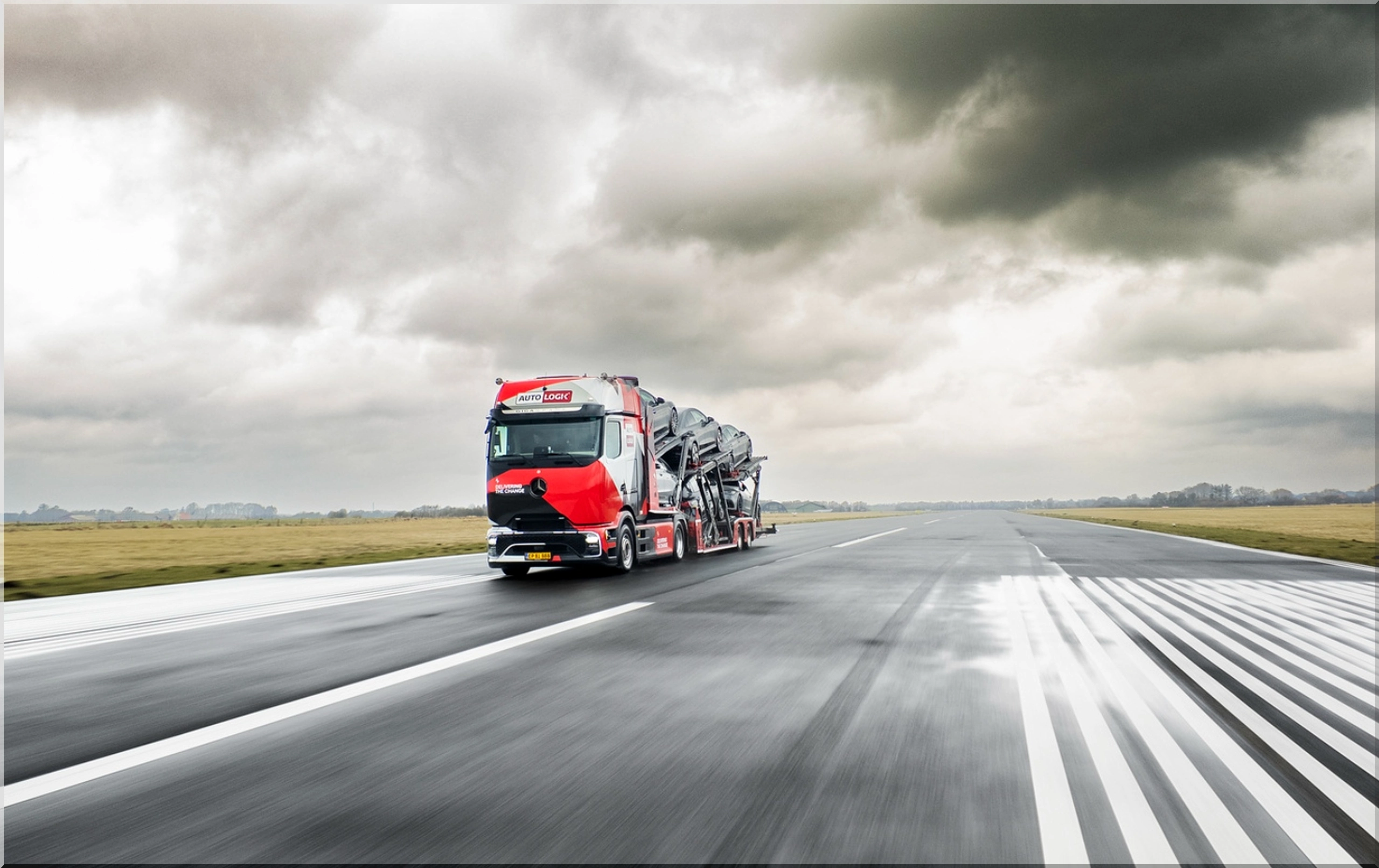
The first Mercedes-Benz eActros 600 electric car transporter in Denmark gives vehicle-logistics fleets a useful real-world case study. Dansk Auto Logik now runs a battery-electric truck between Vamdrup and Bremerhaven, using depot charging in Denmark and public charging in Germany for the return leg.
Why does this electric car transporter matter?
The Danish deployment matters because car transport creates a difficult duty cycle: high frontal area, variable loads, hydraulic loading equipment, cross-border routing, and tight handover timing. Dansk Auto Logik did not choose a short urban loop. It chose a fixed international route of more than 380 km, or about 236 miles, between Denmark and northern Germany.
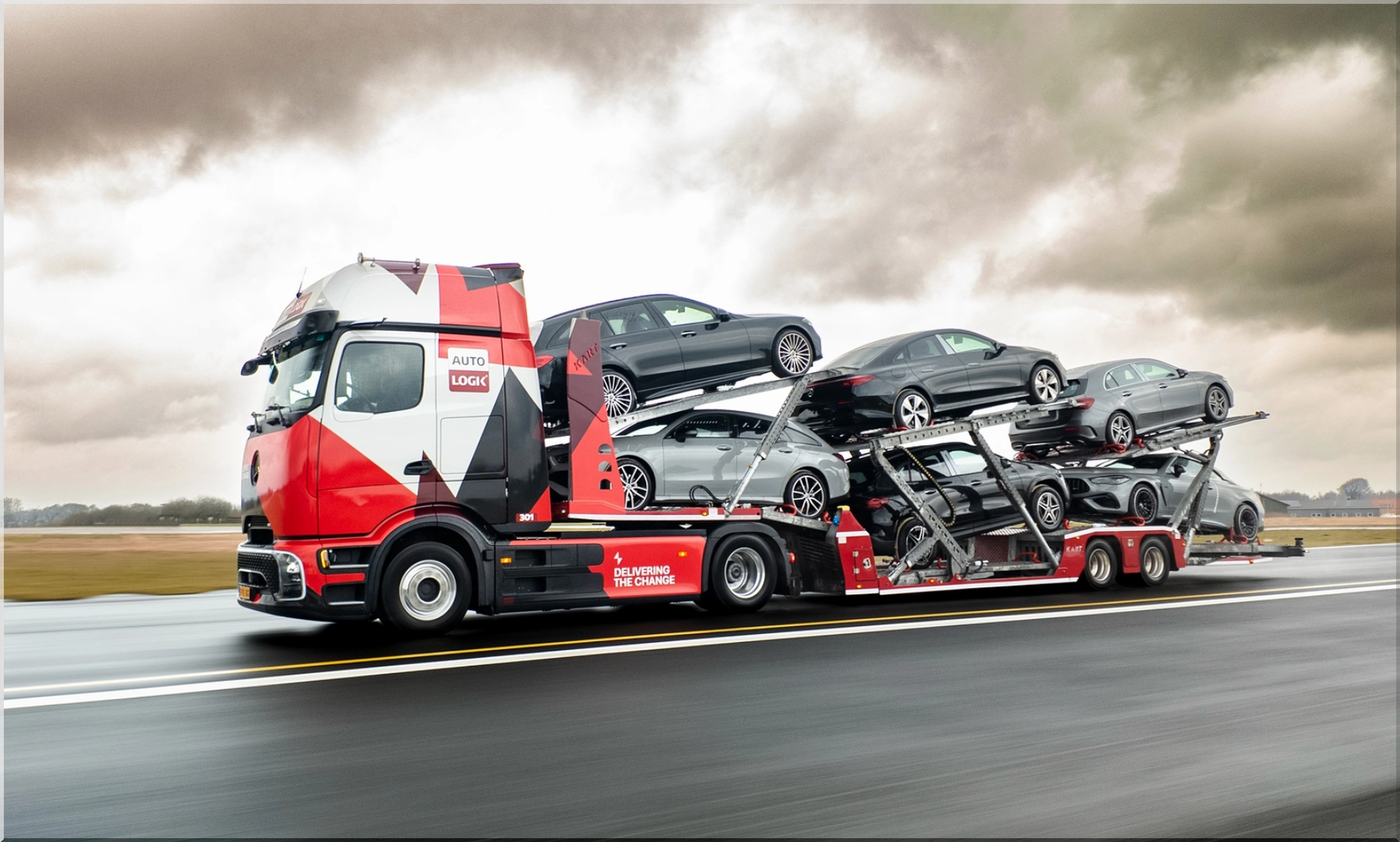
The truck uses a 4x2 eActros 600 tractor unit with ProCabin and a two-axle trailer. It can carry up to six passenger vehicles. In addition, the trailer carries its own battery to power the hydraulic loading and unloading system, which protects the truck's traction battery from accessory drain during vehicle handling.
| Deployment item | Data point | Operational meaning |
|---|---|---|
| Operator | Dansk Auto Logik | Vehicle logistics test case |
| Route | Vamdrup to Bremerhaven | Cross-border Denmark-Germany work |
| Distance | 380+ km / 236+ miles | Near full-shift planning case |
| Tractor | eActros 600 4x2 | Long-haul electric base vehicle |
| Cab | ProCabin | Aero-focused long-distance cab |
| Trailer | Two-axle car transporter | Up to six vehicles |
| Auxiliary power | Separate trailer battery | Main pack preserved for driving |
How does the eActros 600 handle range and charging?
The Mercedes-Benz eActros 600 uses three LFP battery packs, each rated at 207 kWh, for a total installed capacity of 621 kWh. Mercedes targets up to 500 km, or 311 miles, without intermediate charging under defined long-haul test conditions at 40 tonnes gross combination mass.
Looking at the data, the pack-to-range ratio gives a simple planning estimate of 1.24 kWh per km, or about 2.0 kWh per mile, before route-specific variables. Car transporters add aerodynamic drag, so dispatch teams should model speed, wind, deck loading, and return-leg charger reliability before copying the route.
| eActros 600 technical point | Figure | Fleet-use impact |
|---|---|---|
| Battery chemistry | LFP | Long cycle life, no nickel or cobalt |
| Battery layout | 3 x 207 kWh | 621 kWh total installed capacity |
| Claimed range | 500 km / 311 miles | Fits fixed regional corridors |
| CCS2 charging | Up to 400 kW | Practical depot and highway charging |
| Future MCS target | 20-80 percent in about 30 minutes | Strong fit for break-based charging |
| Drive axle output | 400 kW continuous, 600 kW peak | Heavy-load acceleration support |
| Service-life target | 1.2 million km / 746,000 miles | Diesel-like lifecycle planning |
| EU payload with standard semitrailer | Around 22 tonnes | Payload remains the commercial pressure point |
What makes the trailer battery a smart engineering choice?
Specifically, the separate trailer battery solves a real logistics problem. Hydraulic decks consume energy during loading, unloading, and height adjustment, and those operations often happen while the truck sits still. Pulling that energy from the main 621 kWh pack would reduce route margin and add noise to range reporting.
From an expert perspective, this separation creates cleaner fleet data. The operator can judge traction energy, charging time, route speed, and payload impact without mixing in hydraulic consumption from terminal work.
Should vehicle-logistics fleets copy this route model?
Fleets should copy the method before they copy the vehicle. Dansk Auto Logik uses a fixed corridor, own charging points at Vamdrup, and public charging on the German return leg. Consequently, the project tests the full operating chain: vehicle, route, charger access, scheduling discipline, and cost control.
Pro-Tips for fleet managers:
- Start with one repeatable corridor under 400 km / 249 miles.
- Add depot charging before ordering multiple trucks.
- Track kWh per loaded km and empty km separately.
- Use trailer auxiliary batteries for hydraulic transport bodies.
- Audit public chargers by uptime, plug type, queue risk, and truck access.
What is the fleet ROI signal?
The ROI signal comes from predictability, not hype. A fully electric car transporter can work when the route stays fixed, charging slots match driver breaks, and the operator controls at least one end of the charging plan. By comparison, irregular long-haul work with unknown public charger access still carries higher risk.
In addition, the eActros 600 platform now supports more than 40 base-vehicle variants across battery packs, cab types, wheelbases, and axle layouts. That matters for operators that need payload, range, body-builder integration, or driver comfort to lead the purchase case.
- Add new comment
- 36 views