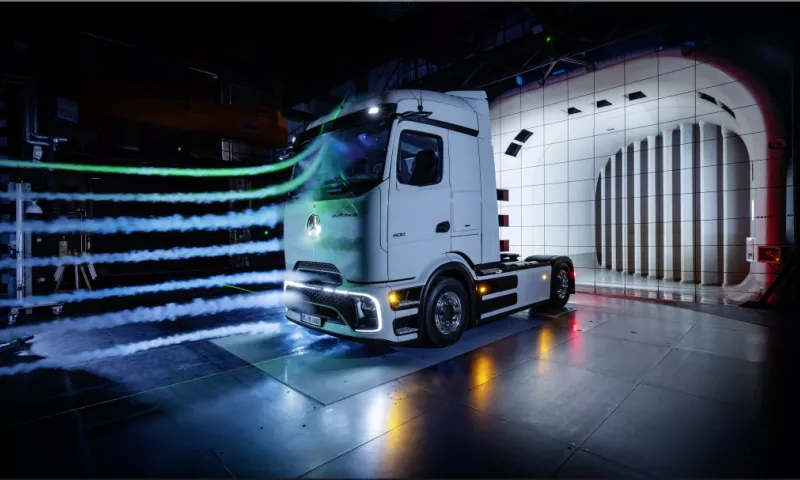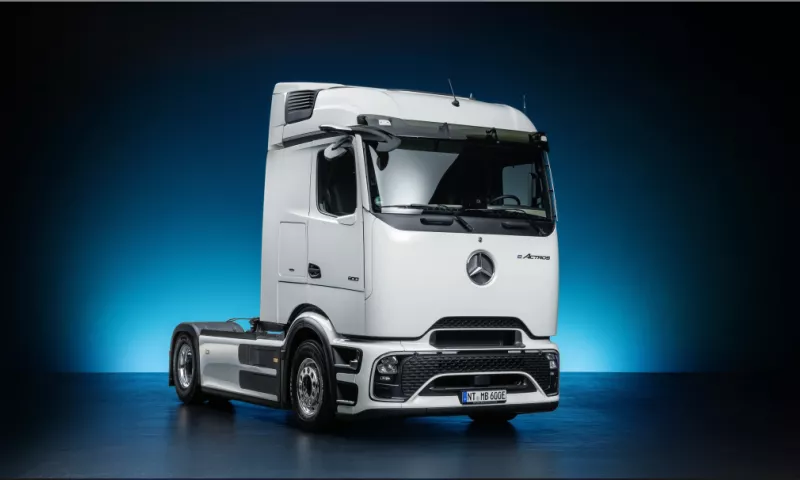
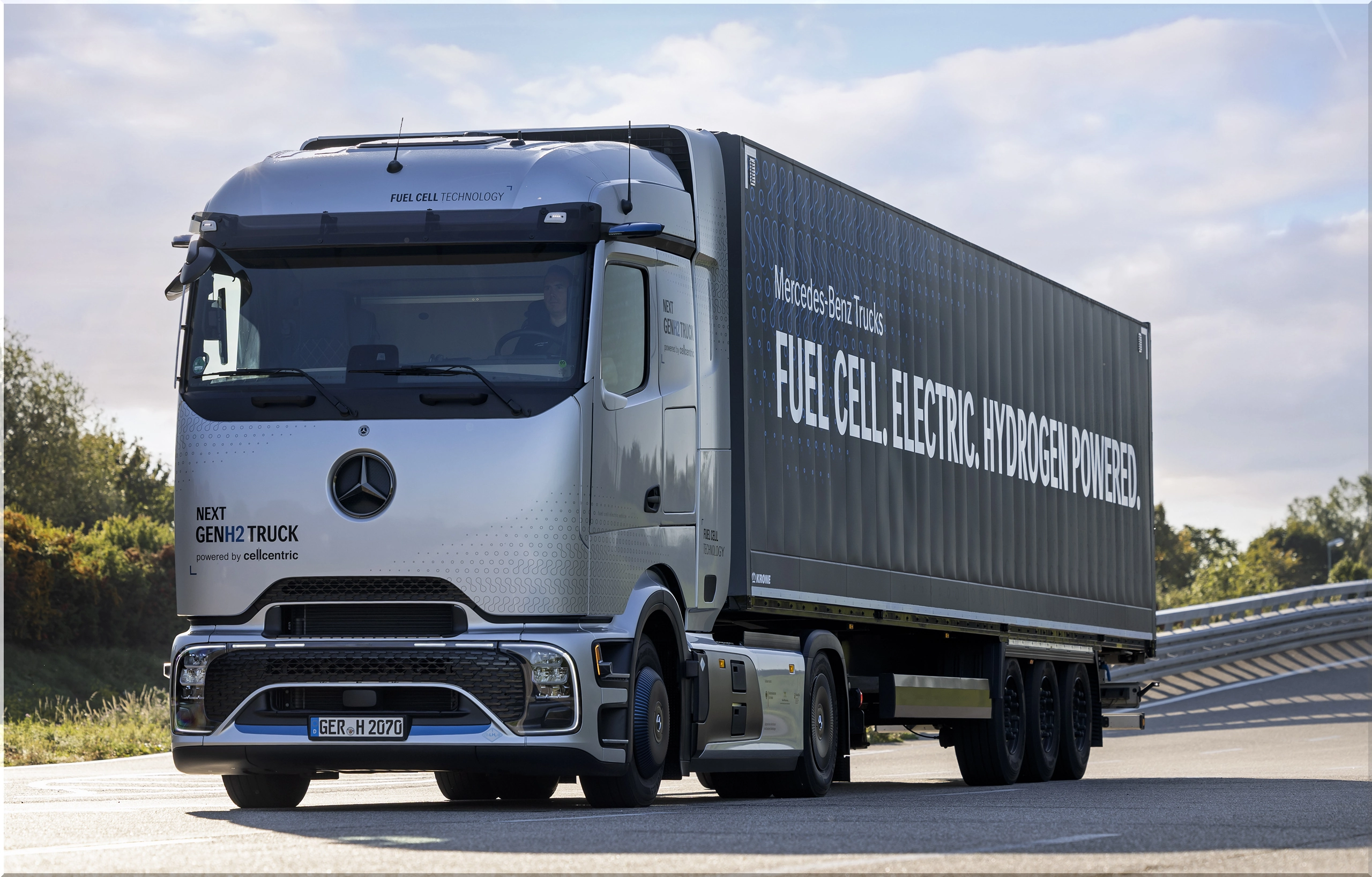
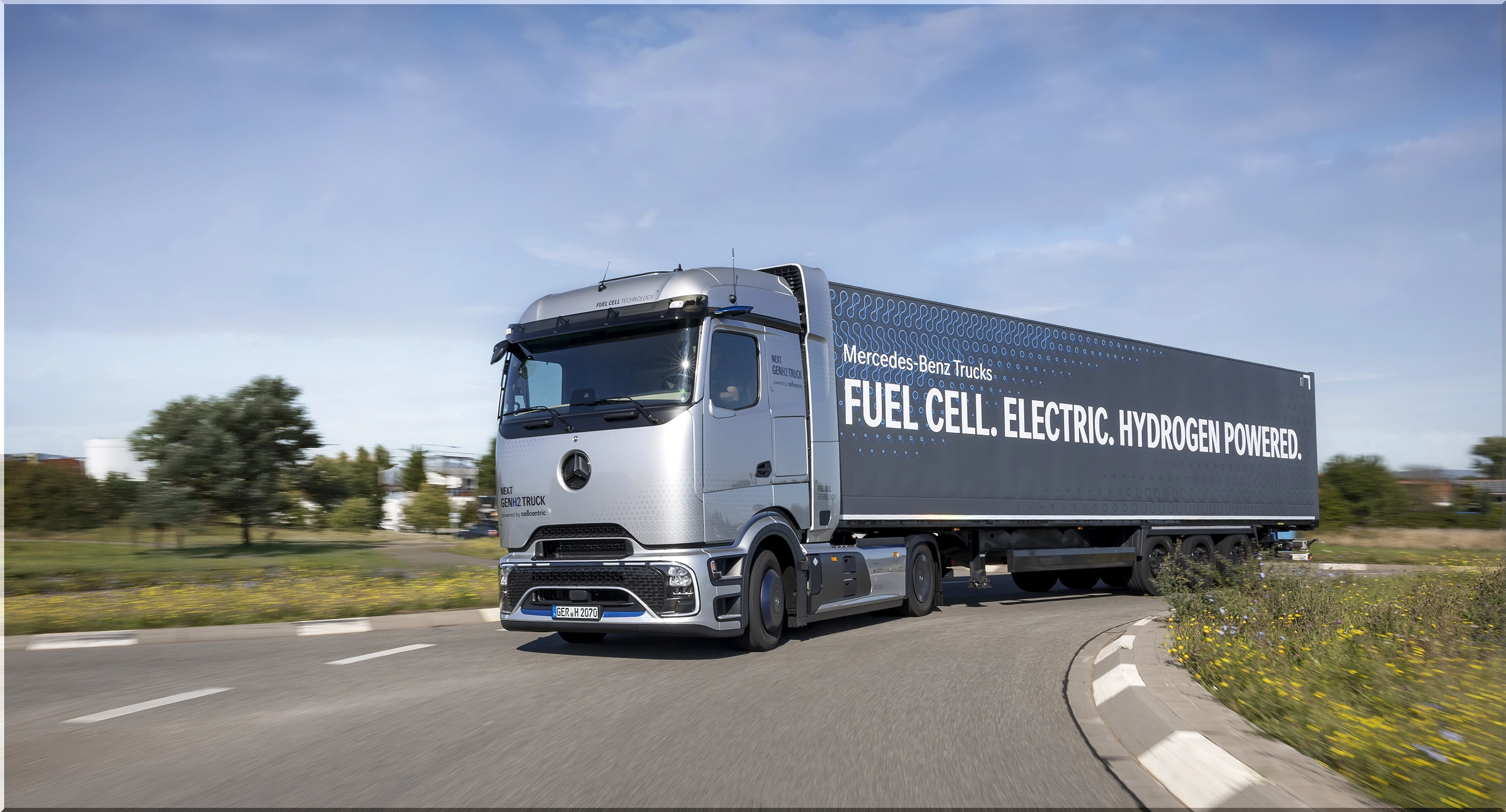
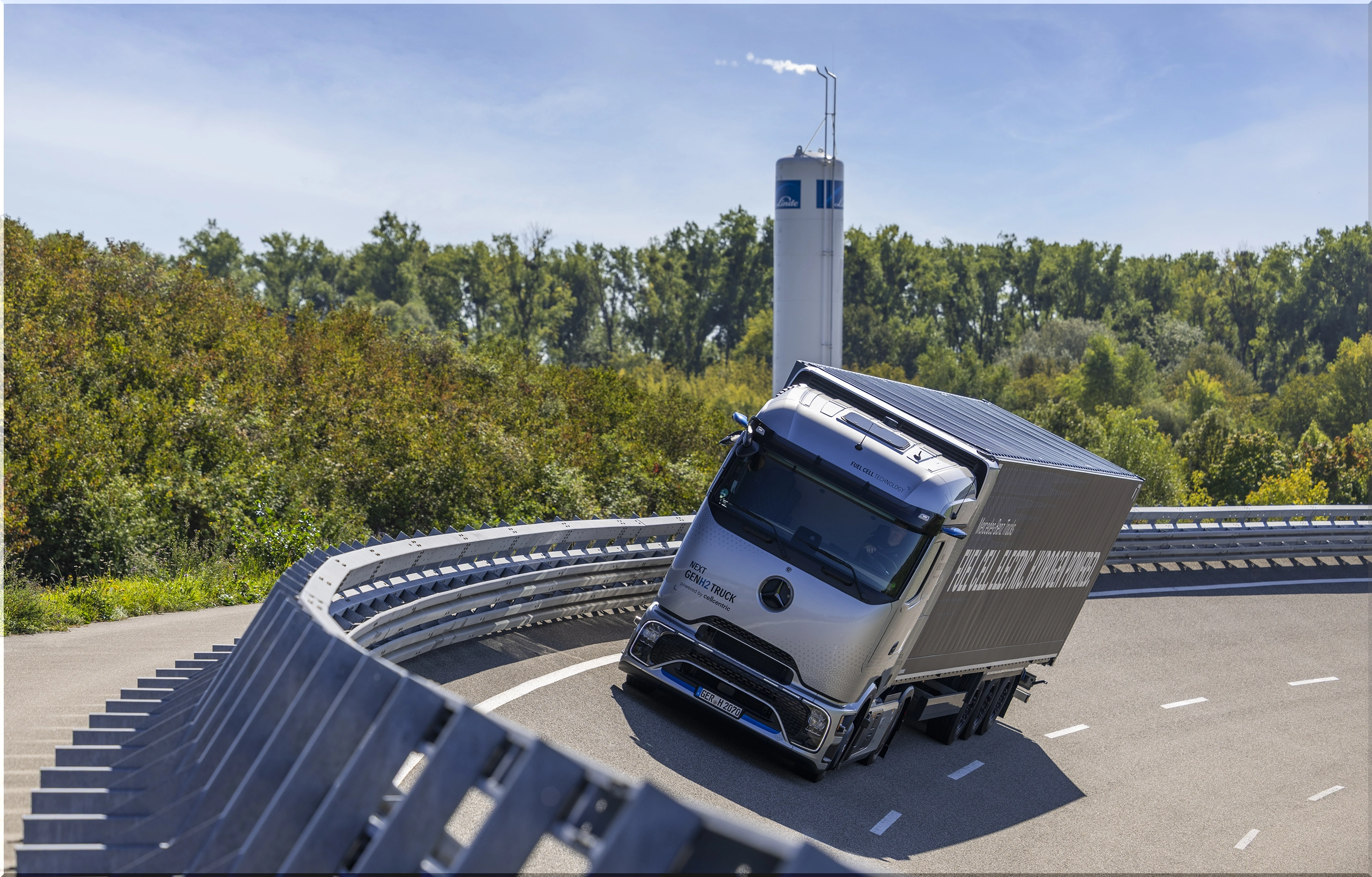
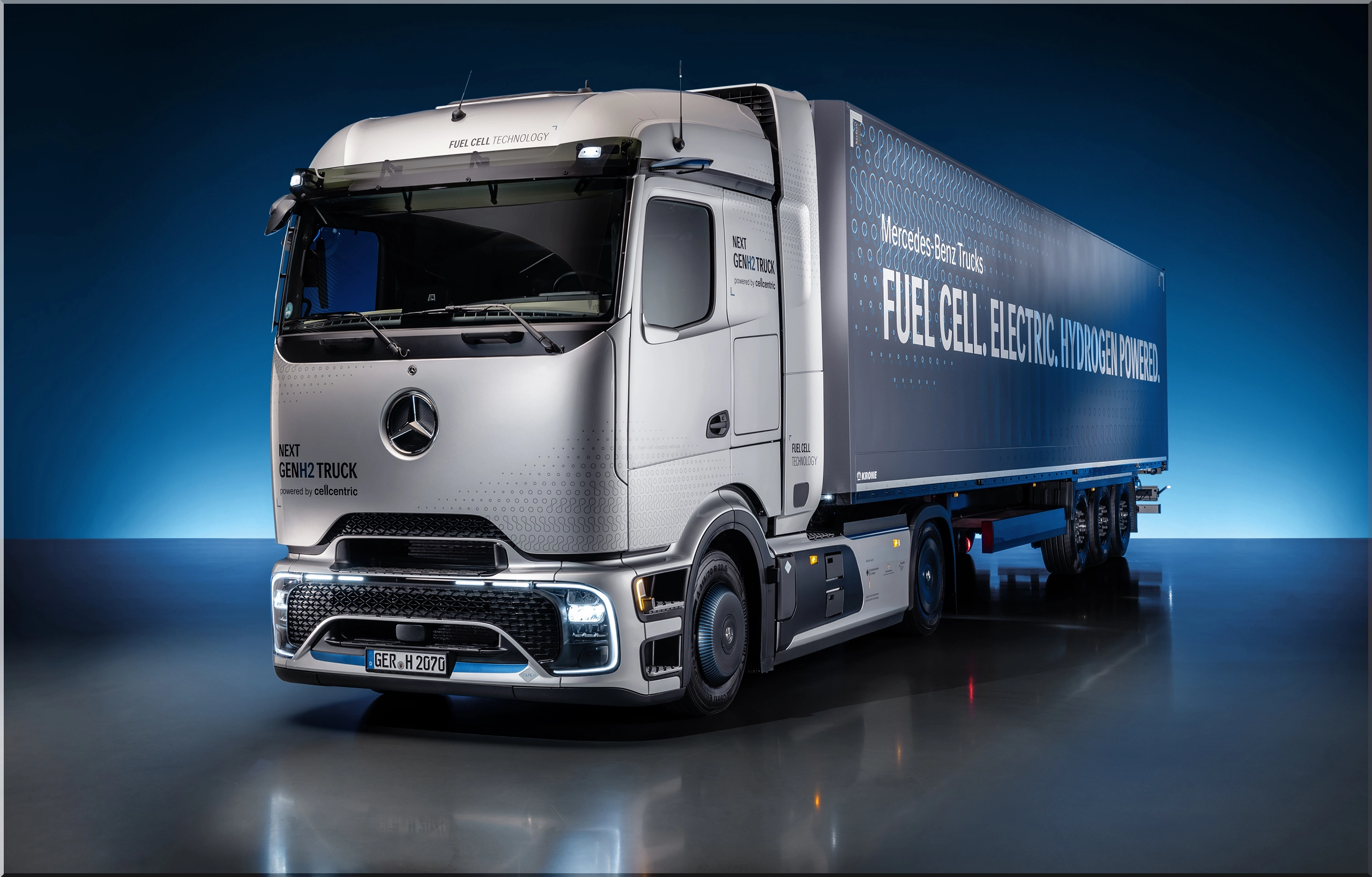
The Mercedes-Benz NextGenH2 Truck aims to give long-haul fleets an electric drivetrain with diesel-style refuelling schedules. Daimler Truck's November update sets customer operations for 2027, with 100 trucks planned. The business case depends on dependable liquid hydrogen refuelling along every contracted route.
Why does Mercedes-Benz use liquid hydrogen in trucks?
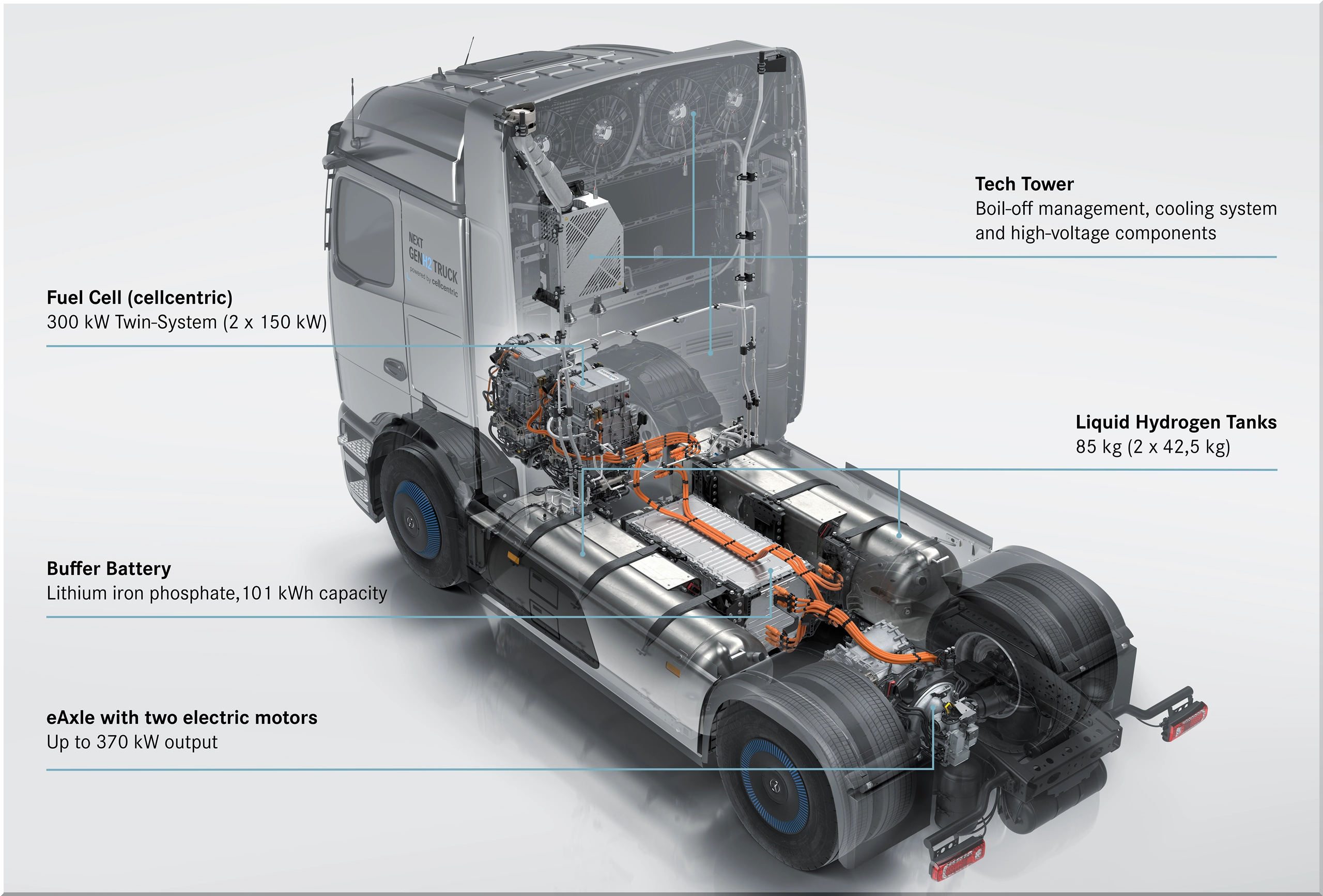
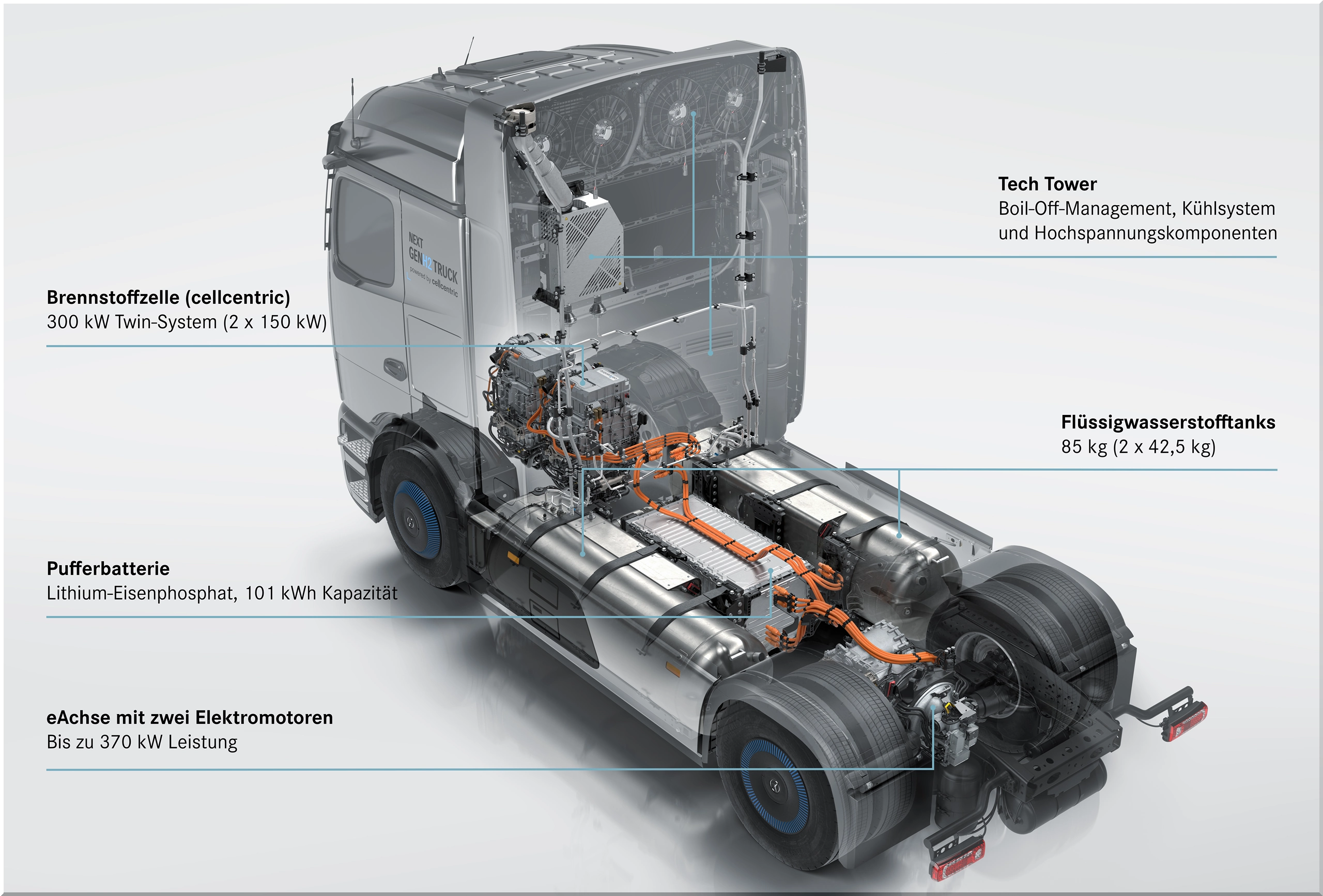
Mercedes-Benz chooses liquid hydrogen because cryogenic storage puts more fuel into the available chassis space than compressed gas. The NextGenH2 holds up to 85 kg at approximately -253°C (-423°F). Daimler claims more than 1,000 km (621 miles) of fully loaded range, with short refuelling stops.
| NextGenH2 hardware | Specification | Operational purpose |
|---|---|---|
| Hydrogen storage | Two connected tanks; 85 kg (187 lb) total | Refuelling access from either side |
| Cellcentric BZA150 fuel cells | Two 150 kW units; 300 kW combined | Generate electricity onboard |
| Driving power | Up to 340 kW Economy; 370 kW Power | Match output to driving demands |
| LFP buffer battery | 101 kWh nominal capacity | Support acceleration and capture braking energy |
| Transmission | Four-speed; two reverse gears | Manage electric axle power delivery |
| Wheelbase | 4,000 mm (157.5 inches) | Accommodate standard European trailer combinations |
The buffer battery helps power acceleration and captures energy during braking. Tighter component packaging behind the cab trims 150 mm (5.9 inches) from the wheelbase. To assess payload, fleets must weigh the complete tractor and check axle limits; tank weight alone cannot settle the calculation.
How does NextGenH2 compare with the eActros 600?
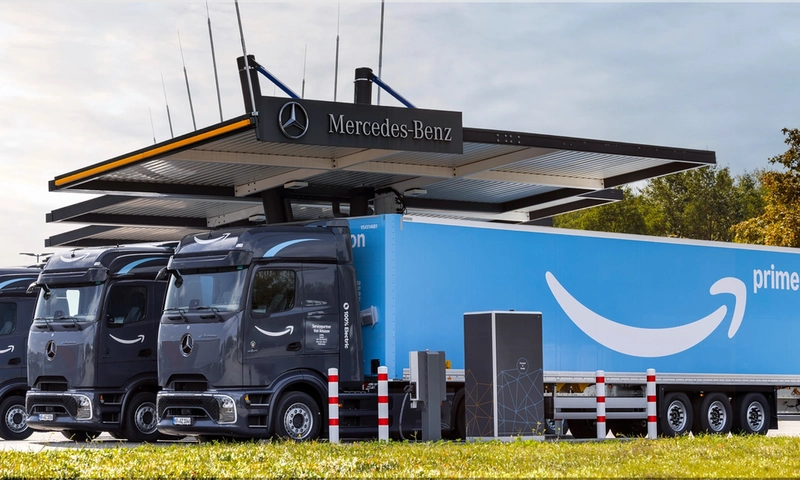
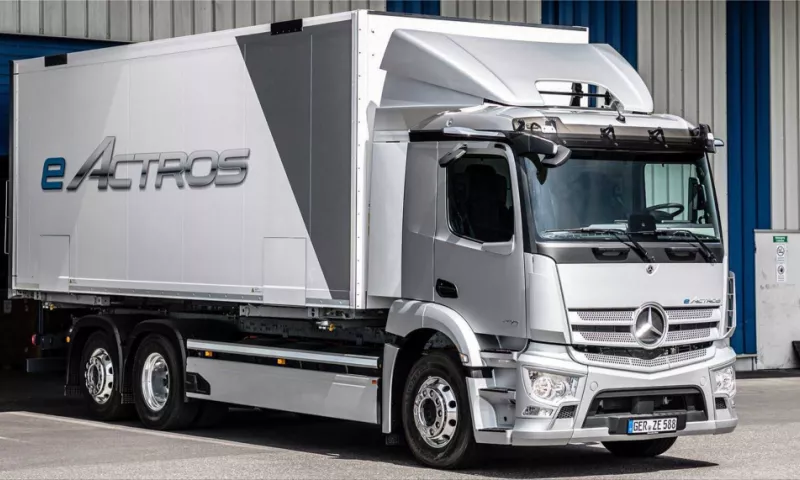
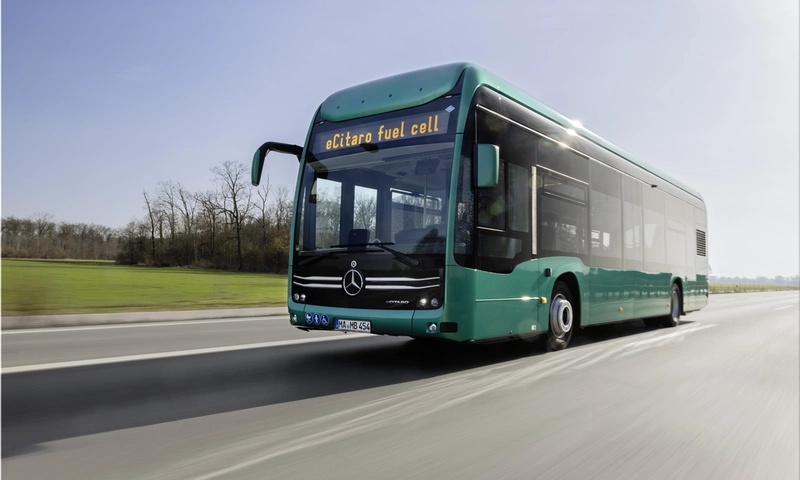
The eActros 600 provides a battery-electric benchmark for the same long-haul tractor category. NextGenH2 promises more distance between energy stops, while the eActros already serves customers in series production. Match the truck to its duty cycle, then check whether charging and liquid hydrogen supply can support the full route.
| Fleet metric | Mercedes-Benz NextGenH2 | Mercedes-Benz eActros 600 |
|---|---|---|
| Energy carrier | Liquid hydrogen | Grid electricity |
| Installed battery capacity | 101 kWh buffer | 621 kWh traction battery |
| Manufacturer's range | Well over 1,000 km (621 miles), fully loaded | 500 km (311 miles), 40-tonne combination |
| Energy replenishment | Full refill in 10-15 minutes; ISO 13984 | DC Fast Charging; duration depends on charging system |
| Market status | 100-truck programme for customer operations from 2027 | Series production since 2024 |
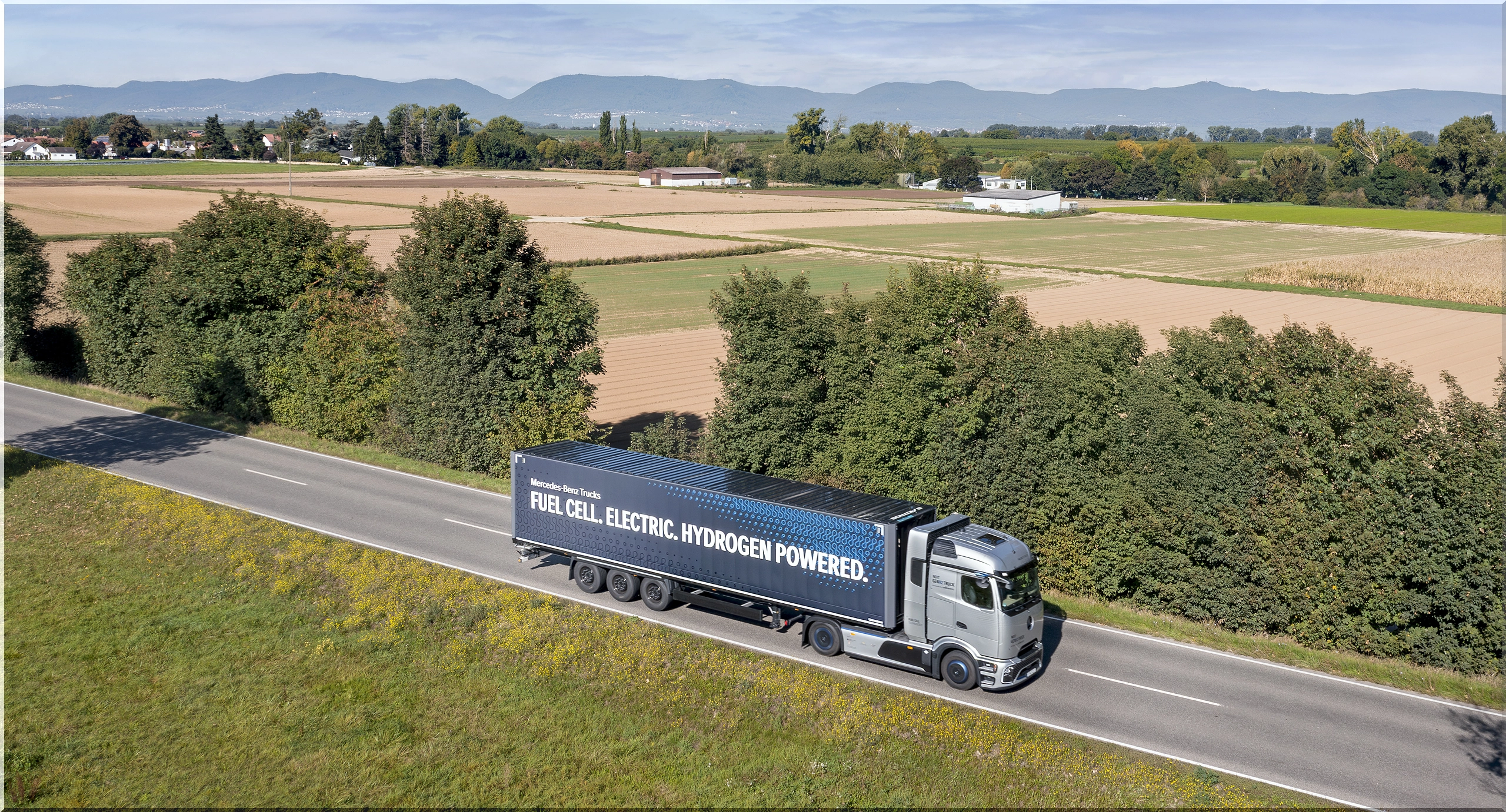
Daimler's eActros range figure assumes 20°C (68°F). Fleets cannot use these manufacturer figures to establish a matched efficiency comparison. Five first-generation GenH2 trucks have covered over 600,000 km (372,823 miles) across ten customers. Their operating experience feeds further development.
Current customer trials rely on refuelling in Wörth am Rhein and the Duisburg area. Check station compatibility and detour distance before assigning routes.
When does liquid hydrogen make financial sense for fleets?
Delivered fuel prices, station access and vehicle costs decide the business case for liquid hydrogen. At an illustrative 8 kg/100 km (12.9 kg/100 miles) and $10/kg (USD), fuel alone costs $0.80/km ($1.29/mile). Treat these numbers as budgeting assumptions for sensitivity testing, and check them against actual route consumption and delivered fuel quotes.
By comparison, a battery truck consuming an assumed 1.2 kWh/km (1.93 kWh/mile) at $0.20/kWh costs $0.24/km ($0.39/mile). Those inputs put hydrogen's energy-only break-even price at $3/kg. The calculation excludes vehicle and infrastructure costs.
Daimler reports electricity use of 0.05 kWh/kg at the Wörth pilot station. That works out to 4.25 kWh for an 85 kg fill. Count upstream hydrogen production, liquefaction and delivery separately when comparing energy demand and emissions across the entire supply chain.
Pro-Tips for fleet buyers:
- Secure a liquid hydrogen supply contract and confirm a backup refuelling option.
- Calculate total cost of ownership with finance, maintenance, payload and station detours.
- Check parking procedures and boil-off management with the supplier.
- Add new comment
- 1 view