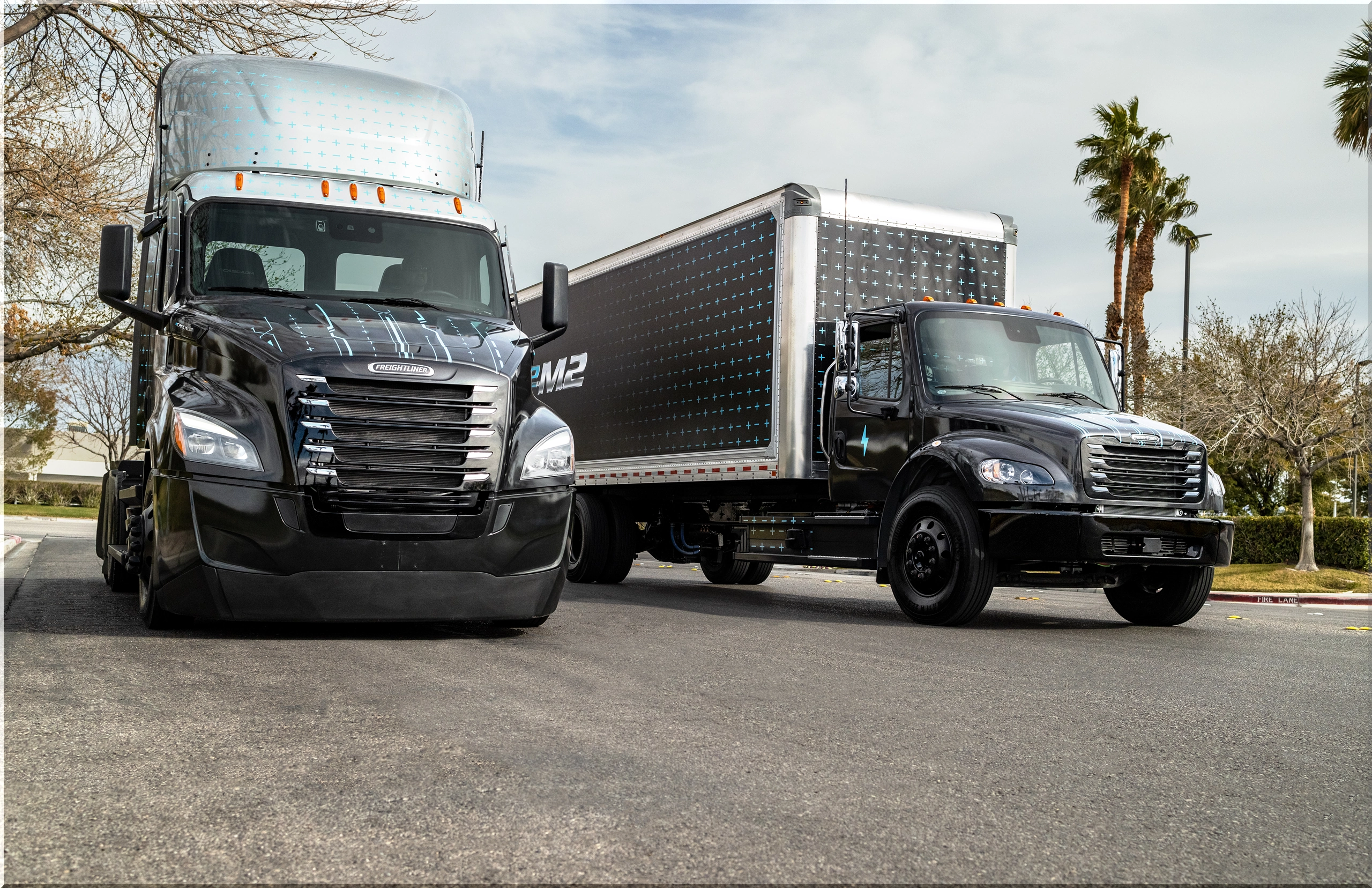
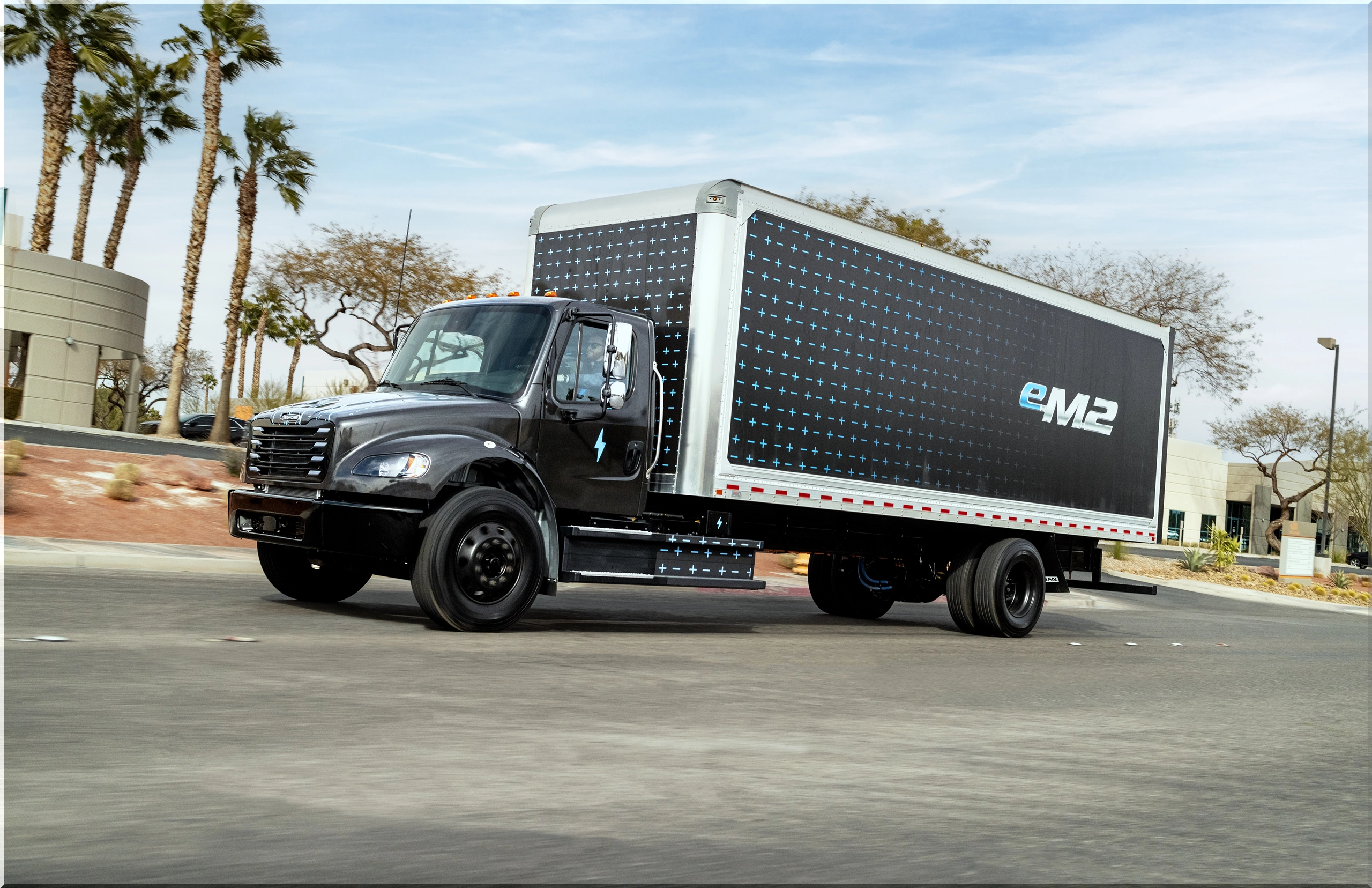
The Freightliner eM2 targets a clear assignment: replace diesel box trucks on predictable delivery routes that return to a depot. Its Class 6 and Class 7 configurations offer different battery, weight, and power combinations. The buying decision starts with loaded-route energy demand and body weight, rather than advertised range alone.
What range and specifications does the Freightliner eM2 offer?
Freightliner lists typical ranges of 180 miles (290 km) for Class 6 and 250 miles (402 km) for Class 7. Their usable batteries hold 194 kWh and 291 kWh. The larger truck carries 50% more battery energy but gains roughly 39% more advertised range, so battery capacity alone cannot predict route efficiency.
| Specification | Class 6 eM2 | Class 7 eM2 |
|---|---|---|
| Usable battery capacity | 194 kWh | 291 kWh |
| Typical range | 180 miles / 290 km | 250 miles / 402 km |
| Continuous power, Economy mode | 190 hp / 142 kW | 255 hp / 190 kW |
| Motors on Detroit eAxle | One | Two |
| Gross vehicle weight rating | 26,000 lb / 11,793 kg | 33,000 lb / 14,969 kg |
| Approximate cab/chassis/powertrain weight | 12,980 lb / 5,888 kg | 16,230 lb / 7,362 kg |
| Remaining allowance before body, people, and cargo | 13,020 lb / 5,906 kg | 16,770 lb / 7,607 kg |
Freightliner's FAQ also quotes 190 miles for Class 6, conflicting with its headline specifications and launch article. Use 180 miles for initial screening and validate the truck on your route.
The specification page lists overall lengths of 319-391 inches (8,103-9,931 mm), a 100-inch (2,540-mm) width, and a 106-inch (2,692-mm) bumper-to-back-of-cab dimension. Height reaches 102.5 inches (2,604 mm), or 137.4 inches (3,490 mm) with the roof fairing.
How much payload can the eM2 actually carry?
The eM2's payload capacity depends on the finished truck, because its published chassis weights exclude the cargo body, driver, and equipment. Subtract those items from the remaining weight allowance before assigning freight. A heavier refrigerated body or liftgate reduces cargo capacity even when the vehicle retains exactly the same gross weight rating.
An illustrative 4,000-lb (1,814-kg) allowance for body, equipment, and occupants leaves about 9,020 lb (4,091 kg) for Class 6 cargo or 12,770 lb (5,792 kg) for Class 7. Verify axle loads separately.
The Detroit ePowertrain places its motors and two-speed transmission directly on the drive axle. This layout removes the conventional driveshaft and central transmission arrangement, reducing mechanical hardware. Regenerative braking recovers some deceleration energy during repeated delivery stops.
How should fleets plan charging and daily range?
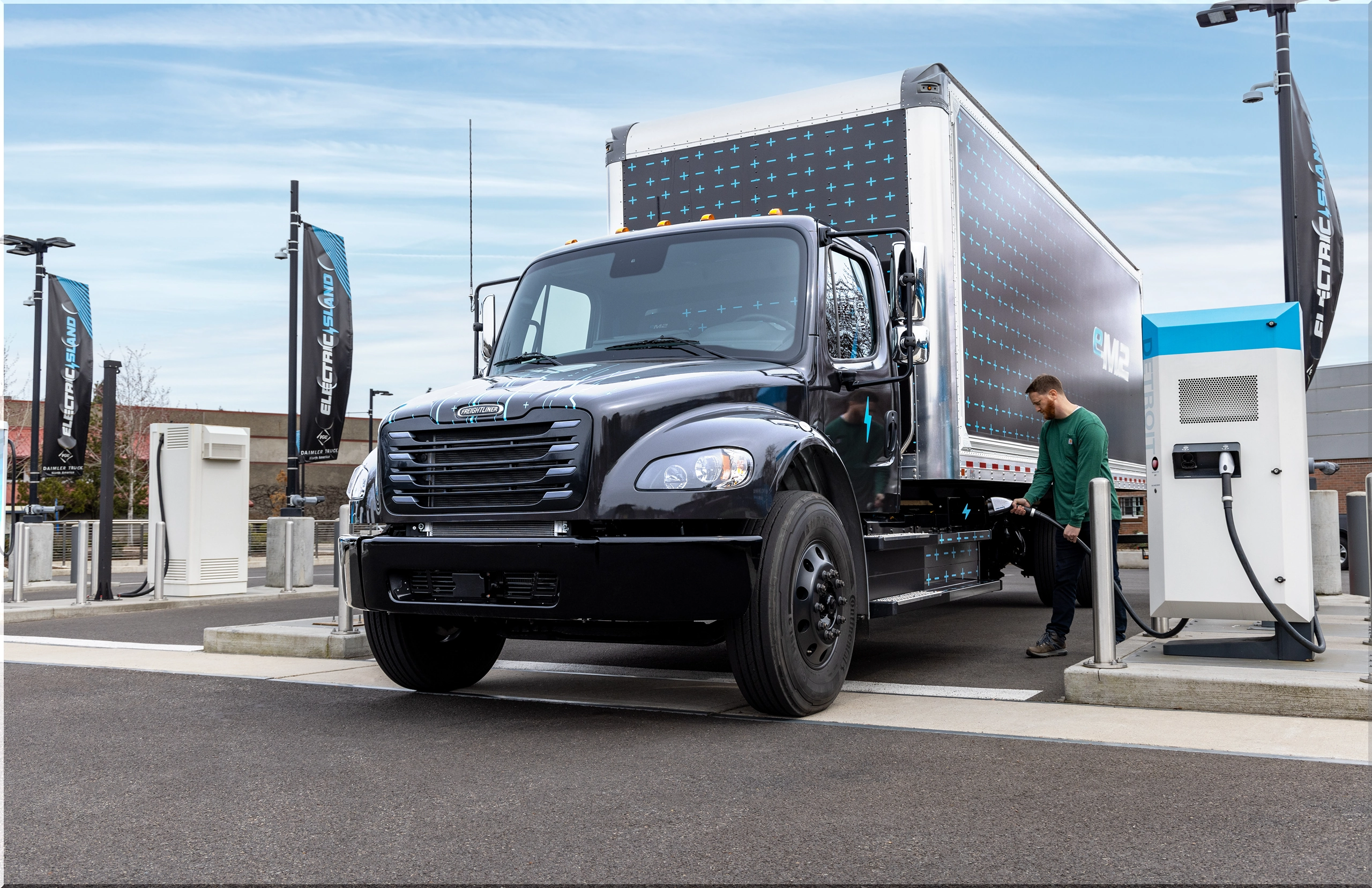
Plan depot charging around the energy each shift consumes and the time trucks remain parked. Freightliner advertises approximately 60 minutes from 0% to 80%, but fleets should confirm charger requirements and conditions for their configuration. Overnight charging can avoid dependence on a short, high-power charging window between delivery shifts.
The following calculations divide usable battery capacity by advertised range. They provide screening estimates, not measured consumption. Both trucks start full and cover 120 miles (193 km); the illustration assumes 90% charging efficiency and electricity at $0.15/kWh.
| Calculated planning metric | Class 6 | Class 7 |
|---|---|---|
| Battery energy per mile / km | 1.08 / 0.67 kWh | 1.16 / 0.72 kWh |
| Battery energy for route | 129.3 kWh | 139.7 kWh |
| Grid energy to replenish route | 143.7 kWh | 155.2 kWh |
| Route electricity cost | $21.56 | $23.28 |
| Range allowance with 20% battery reserve | 144 miles / 232 km | 200 miles / 322 km |
Before purchasing, test:
- Maximum dispatch weight and the actual delivery sequence.
- Winter heating, refrigeration, hills, and highway speeds.
- Simultaneous charging demand across the entire depot.
Can the Freightliner eM2 reduce fleet operating costs?
The eM2 can cut energy spending when depot electricity costs less per mile than diesel, but purchase and infrastructure costs determine payback. Freightliner directs buyers to dealers for pricing. Compare complete vehicle quotes, charger installation, utility demand charges, maintenance, and financing before treating an energy saving as a total ownership saving.
By comparison, an assumed diesel truck returning 8 mpg at $4/gallon spends $60 on the same 120-mile route. The illustration gives the eM2 an energy-only saving of about $37-$38 per working day, or $9,200-$9,600 over 250 days. These assumptions describe a budgeting scenario, not a fleet test.
Pro-Tip: Request a fully bodied demonstration truck and meter electricity at the charger. Price the route using purchased kWh, then check the truck's remaining charge after its hardest shift.
- Add new comment
- 3 views